🚚 Free Shipping Across India
💳 Get Extra 3% OFF on Prepaid Orders
🏸 Trusted by Players, Clubs & Academies
⭐ Premium Tournament Grade Sports Equipment
📞 Bulk Orders & Dealer Enquiries Welcome
🚚 Free Shipping Across India
💳 Get Extra 3% OFF on Prepaid Orders
🏸 Trusted by Players, Clubs & Academies
⭐ Premium Tournament Grade Sports Equipment
📞 Bulk Orders & Dealer Enquiries Welcome
🚚 Free Shipping Across India
💳 Get Extra 3% OFF on Prepaid Orders
🏸 Trusted by Players, Clubs & Academies
⭐ Premium Tournament Grade Sports Equipment
📞 Bulk Orders & Dealer Enquiries Welcome
🚚 Free Shipping Across India
💳 Get Extra 3% OFF on Prepaid Orders
🏸 Trusted by Players, Clubs & Academies
⭐ Premium Tournament Grade Sports Equipment
📞 Bulk Orders & Dealer Enquiries Welcome
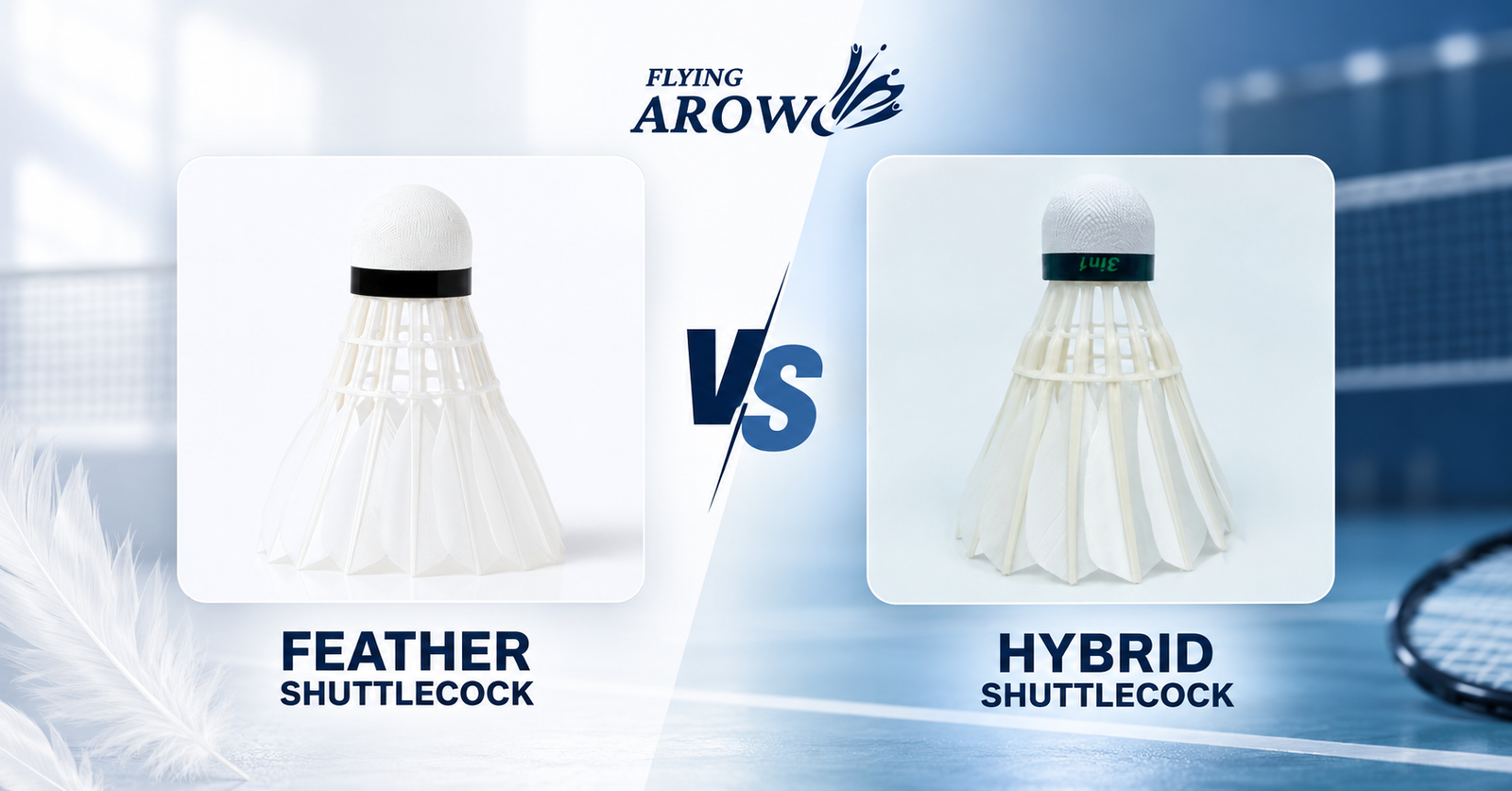
Feather vs Hybrid Shuttlecocks: Which One Should You Choose?
Feather and hybrid shuttlecocks can look similar at first glance, but their construction,
durability, flight characteristics and ideal use cases are different.
If you are trying to decide between a
feather vs hybrid shuttlecock,
the right choice depends on how and where you play. Competitive badminton players
generally look for the natural flight and hitting response of feather shuttlecocks,
while players, coaches and clubs doing frequent training may value the added durability
of a hybrid construction.
In this guide, we compare the two options and explain when a
feather shuttlecock or hybrid shuttlecock
makes more sense.
Quick Answer: Feather or Hybrid Shuttlecock?
Choose a feather shuttlecock when your priority is natural flight,
precise trajectory, authentic hitting feel and competitive-style play.
Choose a hybrid shuttlecock when durability, training value and
longer playing sessions are more important.
In the Flying Arow range, the
FA-10 Feather Shuttlecock is designed for serious and competitive
players, while the HB-09 Hybrid 3in1 combines cork, nylon and feathers
for training and recreational use.
At a Glance
Feather vs Hybrid Shuttlecocks: The Main Difference
The biggest difference is construction. Natural feather shuttlecocks use a feather
skirt, while hybrid designs combine different materials to balance natural flight
characteristics with improved durability.
Natural Performance
Feather Shuttlecock
Best suited to players who prioritise natural shuttle flight, precise trajectory,
control and a traditional badminton hitting feel.
Flying Arow example: FA-10 Feather Shuttlecock.
Training Value
Hybrid Shuttlecock
Designed to combine selected natural and synthetic materials, providing a balance
between realistic flight and improved durability.
Flying Arow example: HB-09 Hybrid 3in1.
Option 01
What Is a Feather Shuttlecock?
A feather shuttlecock uses natural feathers to form the skirt of the shuttle.
The BWF Laws of Badminton specify 16 feathers for a standard feather shuttlecock,
with defined dimensions and weight requirements. :contentReference[oaicite:2]{index=2}
Natural feather construction is widely preferred when players want the flight
characteristics associated with traditional competitive badminton.
01
Natural Flight
Feather construction provides the traditional flight behaviour expected from
a natural badminton shuttle.
02
Precise Trajectory
Players who depend on controlled clears, drops, drives and smashes often value
the predictable response of a quality feather shuttle.
03
Traditional Hitting Feel
A quality feather shuttle provides the familiar contact and response many
experienced badminton players expect.
04
Competitive Use
Feather shuttlecocks are the natural choice when players want a traditional
competitive badminton setup.
Option 02
What Is a Hybrid Shuttlecock?
A hybrid shuttlecock combines different materials in the shuttle's construction.
The aim is to retain useful flight characteristics while improving durability and
value for repeated practice.
The Flying Arow HB-09 Hybrid 3in1 combines a cork base,
nylon and feathers. Flying Arow positions it for training and recreational play,
with speeds 76 and 77 available. :contentReference[oaicite:3]{index=3}
01
Hybrid Construction
The HB-09 combines cork, nylon and feathers rather than relying entirely
on natural feathers.
02
Longer Training Life
The hybrid structure is designed to withstand repeated training and rallying
better than a conventional natural-feather setup.
03
Balanced Flight
The HB-09 is designed to provide a stable and predictable flight while improving
durability for practice.
04
Training Friendly
It is particularly suited to players, coaches, clubs and recreational sessions
where shuttle consumption can be high.
Performance Factor 01
Feather vs Hybrid Shuttlecock: Flight and Stability
Flight is one of the biggest reasons experienced players notice the difference
between shuttlecock constructions.
A quality natural feather shuttle is designed around the aerodynamic behaviour of
feathers. The BWF Laws state that shuttle flight characteristics should generally
be similar to those produced by a natural feathered shuttle with a cork base. :contentReference[oaicite:4]{index=4}
Simple rule:
If your priority is the most traditional natural badminton flight, choose a
quality feather shuttle. If you need a more durable training option with
realistic flight characteristics, a hybrid can be a practical alternative.
Performance Factor 02
Which Is More Durable: Feather or Hybrid Shuttlecocks?
In general, hybrid construction is intended to improve durability by reducing the
amount of wear placed on the natural-feather components during repeated play.
This makes hybrid shuttlecocks particularly useful for high-volume practice,
coaching drills, club sessions and recreational games where several shuttles can
be used in one session.
Natural feather shuttlecocks, meanwhile, remain the preferred choice when players
prioritise authentic flight and competitive playing characteristics.
Choose Feather
Maximum Natural Feel
Prioritise natural flight, trajectory and traditional badminton response.
Choose Hybrid
Frequent Training
Prioritise durability and value during repeated practice sessions.
For Clubs
Balance Cost & Use
Hybrid construction can be practical when shuttle replacement is a frequent
training expense.
Performance Factor 03
Hitting Feel, Control and Accuracy
The shuttlecock affects how the racket feels at impact. Players who are accustomed
to natural feather shuttles may notice differences when moving to synthetic or
hybrid constructions.
The Flying Arow FA-10 uses goose feathers and a two-layer wood cork base and is
designed around accuracy, stability and a crisp hitting response. :contentReference[oaicite:5]{index=5}
The HB-09 instead uses cork, nylon and feathers to balance durability with stable
flight and training performance. :contentReference[oaicite:6]{index=6}
For advanced players:
If you are preparing for competitive matches and want your training shuttle to
closely reflect match conditions, using the same type of shuttle construction
consistently can help keep your practice experience more familiar.
Training Guide
Which Shuttlecock Is Better for Training?
For frequent training, a hybrid shuttlecock can make practical sense because
durability becomes a major consideration.
Multi-shuttle drills, repeated clears, smash practice, defensive drills and
academy sessions can consume a large number of shuttlecocks. In these situations,
a durable hybrid design can help reduce how often shuttles need to be replaced.
Training Pick
Flying Arow HB-09 Hybrid 3in1 Shuttlecock
A cork, nylon and feather hybrid designed for training and recreational play.
The HB-09 is available in speeds 76 and 77 and packs of
1, 3 and 5. Flying Arow describes it as suitable for beginners, intermediate
players, recreational players and badminton academies. :contentReference[oaicite:7]{index=7}
If your priority is competitive-style badminton and natural shuttle performance,
a quality feather shuttlecock is generally the better choice.
The Flying Arow FA-10 is positioned for serious and competitive
players and uses selected goose feathers with a two-layer wood cork base. It is
available in speeds 76 and 77. :contentReference[oaicite:8]{index=8}
Match & Competitive Pick
Flying Arow FA-10 Feather Shuttlecock
Natural feather construction for players who prioritise flight stability,
control and traditional badminton feel.
FeatherGoose
Base2-Layer Wood Cork
Speed76 / 77
UseMatch & Training
The FA-10 is available in packs of 1, 3 and 5 on the main product listing.
Shuttlecock speed matters because playing conditions influence how quickly a
shuttle travels through the air.
Flying Arow currently offers both the FA-10 and HB-09 in speeds
76 and 77. :contentReference[oaicite:9]{index=9}
Speed 76
Slower Option
Often considered when playing conditions call for a slower shuttle speed,
depending on the court environment and local conditions.
Speed 77
Faster Option
A commonly selected speed when a faster flight is appropriate for the
playing environment.
Best Approach
Test Your Court
Temperature, altitude, humidity and indoor airflow can influence how a
shuttle behaves, so testing speed on your actual court is useful.
Important:
Do not choose shuttle speed based only on a general rule. Court conditions and
local environment can change the effective speed of a shuttle.
Side-by-Side Comparison
Feather vs Hybrid Shuttlecock Comparison
Use this quick table to identify which construction better matches your playing needs.
Feature
Feather Shuttlecock
Hybrid Shuttlecock
Construction
Natural feathers + cork
Combination of materials
Flight Feel
Natural and traditional
Balanced and stable
Durability
Good, depending on quality and play
Designed for extended training use
Hitting Feel
Traditional feather feel
Comfortable hybrid response
Best For
Matches & serious play
Training & recreational play
Training Sessions
Excellent
Excellent
Frequent Shuttle Replacement
More likely
Reduced through hybrid construction
Flying Arow Example
FA-10
HB-09
Flying Arow Comparison
FA-10 Feather vs HB-09 Hybrid
If you are specifically comparing the two Flying Arow shuttlecock options,
the decision becomes straightforward.
For Match Performance
FA-10 Feather Shuttlecock
Selected goose feathers, two-layer wood cork construction and a focus on
stable flight and traditional hitting response.
Choose the FA-10 if natural feather flight and traditional match feel are
your priorities.
Choose HB-09
If You Train Often
Choose the HB-09 if you need a more durable shuttle for repeated practice
and regular training.
Choose Based on Your Court
Check Speed
Both Flying Arow models are offered in speeds 76 and 77, allowing you to
select according to playing conditions.
For Badminton Players in India
How to Choose a Shuttlecock in India
Badminton conditions can vary considerably across India. Temperature, humidity,
altitude, indoor ventilation and court conditions can all affect how a shuttle
behaves.
That means there is no single shuttlecock that is perfect for every player,
every court and every training environment.
Instead, consider three things:
Where you play:
indoor court, academy, club or recreational environment.
How often you play:
occasional games require different value considerations than daily training.
Your purpose:
training, coaching, club games, competitive matches or tournaments.
Practical recommendation:
Many players can benefit from keeping both types available — a durable hybrid
shuttle for high-volume training and a quality feather shuttle for match-focused
sessions.
Explore Flying Arow
Explore Flying Arow Badminton Shuttlecocks
Flying Arow offers both feather and hybrid shuttlecock options so players can
choose equipment based on their playing level, training requirements and court use.
Feather
FA-10
Natural goose-feather construction with a two-layer wood cork base.
What is the difference between feather and hybrid shuttlecocks?
Feather shuttlecocks use natural feathers, while hybrid shuttlecocks combine
natural and synthetic materials. Hybrid construction is generally designed to
improve durability while retaining useful flight characteristics.
Is a feather shuttlecock better than a hybrid shuttlecock?
It depends on how you play. Feather shuttlecocks are a strong choice when
natural flight, traditional feel and competitive-style performance are the
priorities. Hybrid shuttlecocks can be better for frequent training where
durability is important.
Which shuttlecock is better for badminton training?
A hybrid shuttlecock can be a practical choice for frequent training because
its construction is designed around durability. The Flying Arow HB-09 is
specifically positioned for training and recreational play.
Which shuttlecock is better for badminton matches?
A quality feather shuttlecock is generally the better choice when players
want natural flight characteristics and a traditional competitive badminton
feel. Flying Arow positions the FA-10 for serious and competitive players.
Are hybrid shuttlecocks durable?
Hybrid shuttlecocks are designed to improve durability by combining materials.
The Flying Arow HB-09 combines cork, nylon and feathers and is positioned for
repeated training and recreational play.
What are speed 76 and 77 shuttlecocks?
Speed ratings indicate how the shuttle is intended to perform in flight.
Playing conditions can influence the appropriate speed, so players should
consider their actual court environment when choosing between speeds.
Which Flying Arow shuttlecock should I choose?
Choose the Flying Arow FA-10 if your priority is natural feather flight and
competitive-style play. Choose the HB-09 Hybrid 3in1 if your priority is
durability and repeated training.
Can I use hybrid shuttlecocks for club training?
Yes. The Flying Arow HB-09 is positioned for training, recreational players,
beginners, intermediate players and badminton academies.
Should I use the same shuttlecock for training and matches?
If you want your training to closely replicate your match experience, using
the same type of shuttlecock can be useful. However, many players use durable
hybrid shuttles for high-volume practice and feather shuttles for match-focused
sessions.
Choose the Shuttlecock That Matches Your Game
Choose natural feather performance for serious match play, or choose hybrid
construction when durability and repeated training are your priorities.
Flying Arow gives you both options.